Documentation just got 10x more valuable
A take on the knowledge paradox: the reader of your documentation changed, so capturing it is suddenly worth far more than tidying it. Talk, transcribe, and spend your time pointing at the work rather than filing it.
The instinct, when your knowledge is a mess, is to go and tidy it. Build the wiki. Pick the workspace. Write the templates. Get everything into one clean, well-named home, and then – finally – let people find what they need.
I think that instinct is now mostly wrong. Not because structure is bad, but because the thing reading your documentation has changed, and almost nobody has updated the job to match.
A recent Notion piece on the “knowledge paradox” is what set me off. It’s a good piece, and it names the gap well: in Notion’s own survey of 650 European companies, 97% said managing knowledge was critical and 28% had any coherent strategy for it. Where I part company is one word. The argument is that you need to get your knowledge house in order before AI – that “AI can only build on what already exists.” True. But “in order” smuggles in an old assumption, and once you drop it, the received wisdom turns over: your documentation is worth far more than it used to be, and you should be making much more of it, much more roughly.
The old reader and the new one
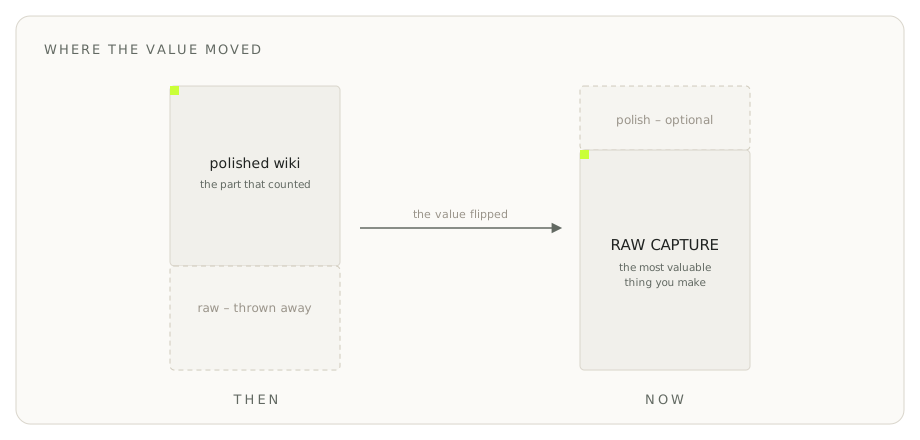
In the old world, “in order” meant tidy. There was one reader: a busy human, skimming for the answer. A human reader needs headings, a clean hierarchy, a sentence that’s been smoothed over. So we paid for that. Every raw call, every messy thread, every half-formed idea got a tax on the way in – someone had to turn it into something presentable before it counted as knowledge.
The new reader doesn’t need any of that. Point a capable model at a raw, unedited meeting transcript and it will read the whole thing, hold all of it, and give you a sourced answer in seconds. The transcript is the least presentable artifact you own. It’s also the most trustworthy, because nobody cleaned it up, and cleaning up is exactly where meaning gets quietly lost. Raw is honest the way a photograph is honest: not flattering, but not lying either.
So the first rule is the cheap one. Capture everything, raw, by default, and don’t make capture wait for polish.
You document by talking now
Here’s the part that still catches people out. Capturing the raw material mostly doesn’t mean writing. It means talking.
The fastest way to document what you’re doing is to say it out loud and record it. Which puts meetings in a strange new light. We spent years treating meetings as the enemy of real work – and plenty of them earned it, the rambling kind, the ones that needed a project manager in the room just to drag everyone back to a point. But the meeting was never the problem. The wasted meeting was.
A good meeting now is a high-signal conversation that happens to be recorded. You talk through the real thing – the decision, the design, the disagreement – in a way that actually captures the information, and you make sure it’s transcribed. If it isn’t transcribed, it genuinely was a waste of time, because the value was never the hour in the room. The value is that the conversation becomes raw material your future self – and your Claude, your Codex, your agents – can read back later. Talk well and record it, and you have documented more in forty minutes than a week of careful note-writing used to manage.
Raw isn’t the whole story
None of this kills the written layer. It changes what it’s for.
When you turn a transcript into a short synthesised document, you are not making the raw material prettier. You are doing the one thing the model can’t do for itself: setting direction. A good synthesis says what mattered in all that talk, what you have decided, and where you want it to go next. A little of that intent travels a very long way – it tells the next agent not just what happened, but what to do with it.
And it works in the other direction too. Given that steer, an AI can reach across everything you have ever captured, pull the relevant pieces, and assemble them into a single document that reflects your thinking right now. That artifact is valuable precisely because it is of the moment: a snapshot of where the work stands and which way it is pointing. Useful to the colleague you hand it to, and useful to a future agent trying to reconstruct what you were thinking back here.
That is the real shift underneath all of this. We have largely stopped doing the computer’s work. Our job now is to direct it – and the synthesised document is how we steer, how we tell the system, and each other, where the work is going.
The catch is that this layer goes off. A synthesis written this morning can describe a world that’s gone by the afternoon, so timestamp it and treat anything more than a few hours old as possibly stale. Stale isn’t useless; it’s a snapshot with a date on it, and you read it knowing the date. The real trap is the six-week-old wiki page that still looks authoritative – polish keeps its confident face long after the facts have moved on.
Keep enough structure for a human in a hurry
So structure isn’t dead. It just has a smaller, clearer job.
If you optimised purely for the AI, you would end up with a flat folder of files, a pile of YAML, and a vector database – and you would never touch any of it directly again. Every lookup would route through an agent. Most of the time that’s fine, until it isn’t: until you’re on your phone, or you want the answer in two seconds rather than two minutes, or, let’s be honest, you have burned through your Claude credits for the day. Sending every question through a reasoning model is powerful and heavy, and you don’t always want heavy.
So you keep just enough structure to stay navigable by a person in a rush. People in a people folder. Transcripts by date. Tasks where the tasks live. Not a beautiful taxonomy – a legible one, the kind you or a cheap lookup tool can search without spinning up a model to go hunting. That’s a far lower bar than the wiki, and it’s the right one.
The part Notion gets right
There is a version of “get your house in order first” that is exactly right, and it deserves its due. It just isn’t about tidiness. It’s about permissions.
The moment an AI can read across all your raw capture, every gap in your access control becomes a leak waiting to happen. Regulated data, client-confidential material, the stuff that’s harmless in a locked drawer and a disaster in a shared index – that has to be gated properly, before rather than after. That is the genuinely foundational work. Not making it presentable. Making sure the wrong person, or the wrong query, can’t pull something they were never meant to see. Get the permissions right and you can afford to relax about the mess. Get them wrong and no amount of polish will save you.
What changed my mind
I made an early version of this argument on stage at an event for AI leaders in London. At the time my own setup was already markdown-first, but my team worked in Notion and Google Drive, so I had built a careful little process: I would decide on the canonical version of a document and sync it out to wherever they were working.
Someone in the room stopped me. Fine, they said – but why don’t you just get the team working in markdown too? I gave the honest answer: I wasn’t sure they would want to, or be ready, or that I could pull the change off. And they pushed straight back. If markdown is the best place to work, and it’s where you work, why would you keep everyone else somewhere worse?
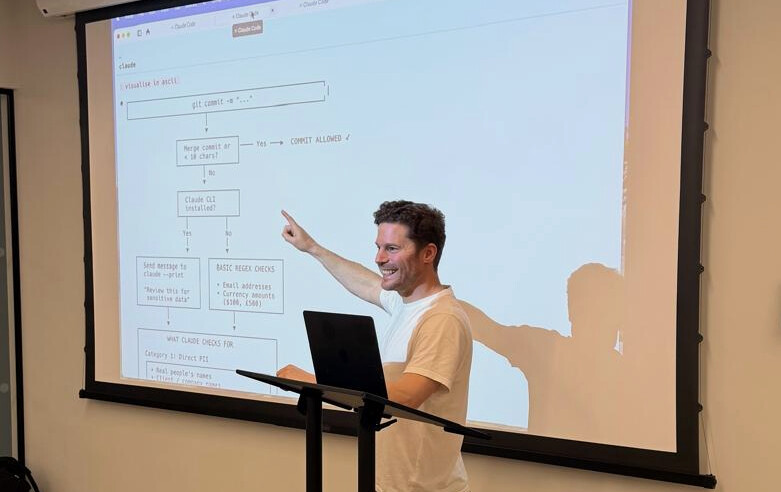
It was a good challenge, and they were right. It pushed me to bring the whole team onto markdown vaults, teach them the basics of Git, and – when the tools we had didn’t quite fit the way we wanted to work – start building one that did. That part is still pre-release, so I’ll leave it there for now. But it’s the same bet as everything above: the capture is the valuable thing, so the capture is the thing you make easy, for everyone.
The knowledge was always there. We just threw most of it away, every day, because catching it cost more than it seemed to be worth. That’s what changed: capture is nearly free now, and a machine can finally read all of it – so the raw material you used to bin is the most valuable thing you make. Capture more. Tidy less. Have the conversation, record it, and say where it goes next.